
SITE GUIDE
SEARCH
REVIEWS
REVIEW ARCHIVES
ADVERTISING AT CURTAINUP
FEATURES
NEWS
Etcetera and
Short Term Listings
LISTINGS
Broadway
Off-Broadway
NYC Restaurants
BOOKS and CDs
OTHER PLACES
Berkshires
London
California
New Jersey
Connecticut
DC
Philadelphia
Elsewhere
QUOTES
On TKTS
PLAYWRIGHTS' ALBUMS
LETTERS TO EDITOR
FILM
LINKS
MISCELLANEOUS
Free Updates
Masthead
Writing for Us
A CurtainUp New Jersey Review
Lost in Yonkers
|
So now Grandma vill tell you vy she doesn't tink you should live vit her. — Grandma
|
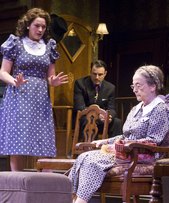
From Left to Right: Sara Surrey (Bella); J. Anthony Crane (Uncle Louis); and Rosemary Prinz (Grandma).
(Photo: Peter Jennings) |
At subsequent productions, it didn't go unnoticed how certain disgruntled members of the audience would get edgy (it wasn't unusual to see more than a few leave at intermission), even upset by the oppressively neurotic currents that flow through this, Simon's best, play. No such unseemly activity occurred on opening night at the Paper Mill Playhouse. Far from the deliberately accessible autobiographical path Simon takes with his trilogy Brighton Beach Memoirs, Broadway Bound and Biloxi Blues, Lost in Yonkers is well-prepared to lose those patrons who prefer their comedy served without pain. Apparently the Paper Mill crowd could both grin and bear it.
Lost in Yonkers rewards the receptive with a more tormenting type of comedy. Director Michael Bloom has fully captured and emphasized the darker side of the play and its characters. The deliberateness of his approach can only be applauded. Bloom, the current artistic director of the Cleveland Playhouse, has brought together a splendid cast headed by theater veteran Rosemary Prinz as the mean-spirited Grandma. But Simon makes his genuinely heart-breaking story appealing by having it viewed through the eyes of two plucky and impressionable teenage boys who are placed in the care of their uncompromisingly hard grandmother, the proprietress of a Yonkers candy store.
The boys are required to serve what they see as a ten-month sentence when their father is forced to accept a traveling job. The year is 1942 and selling scrap metal is one way for the father to pay off a heavy debt to a loan shark who provided the money for the family's medical bills. How the boys not only survive, but help bring about a positive metamorphosis in their highly strung, mentally-challenged Aunt Bella becomes the play's most impassioned central issue. The arrival of an uncle turned gangster and another aunt, suffering from asthma, adds additional emotional fuel to this story of survival.
The role of the can-wielding Grandma, a German Jew who fled Nazi persecution, has a solemn administrator in Rosemary Prinz, whose appearance and conduct announces itself immediately as an occasion for fearsome respect. Her effectiveness is never in question even as she attempts to assert her heretofore unchallenged authority on Jay (Alex Wyse) and Arty (Maxwell Beer), her two grandsons. The fine acting of Wyse and Beer give us an especially winning combination of fear-instilled innocence and rambunctious youth. Beer seems to have injured his hand which was heavily bandaged. A real trouper, it didn't impair his very active performance.
It doesn't take long for Surrey to gain our affection as Bella, the childlike 35 year-old daughter who has remained under her mother's protective domination. J. Anthony Crane's aggressively over-the-top Bogart-by-way-of-Cagney portrayal of Louis the unforgiving wayward son is sharply defined. Patricia Buckley as Gert, the asthmatic daughter, is a tender purveyor of her character's deeply entrenched impairment. It is comforting to have John Plumpis, as Eddie the boys' father, survive his mother's rigidity and coldness with a temperament that is more estranged than deranged. Michael Schweikardt's apartment setting offers its era-marked comforts as well as its accessibility to the candy store below.
|
Lost in Yonkers By Neil Simon Directed by Michael Bloom Cast: Max Beer (Arty), Patricia Buckley (Gert), J. Anthony Crane (Louie), John Plumpis (Eddie), Rosemary Prinz (Grandma), Sara Surrey (Bella), Alex Wyse (Jay) Scenic Design: Michael Schweikardt Costume Design: David Kay Mickelsen Lighting Design: Paul Miller Sound Design: Ken Travis Running Time: 2 hours 45 minutes including intermission Paper Mill Playhouse, Brookside Drive, Millburn, NJ (973) 376 — 4343 Tickets ($25 - $92) Performances: Wednesdays at 7:30 PM, Thursdays at 1:30 and 7:30 PM, Friday at 8 PM, Saturdays at 1:30 and 8 PM and Sundays at 1:30 and 7 PM. Previews began 02/17/2010 Opened 02/21/2010 Ends 03/14/2010 Review by Simon Saltzman based on performance 02/21/2010 |
|
Subscribe to our FREE email updates with a note from editor Elyse Sommer about additions to the website -- with main page hot links to the latest features posted at our numerous locations. To subscribe,
E-mail: esommer@curtainup.comesommer@curtainup.com put SUBSCRIBE CURTAINUP EMAIL UPDATE in the subject line and your full name and email address in the body of the message -- if you can spare a minute, tell us how you came to CurtainUp and from what part of the country. Visit Curtainup's Blog Annex You can also contact us at Curtainup at Facebook . . . Curtainup at Twitter |
|
REVIEW FEEDBACK Highlight one of the responses below and click "copy" or"CTRL+C"
Paste the highlighted text into the subject line (CTRL+ V): >Feel free to add detailed comments in the body of the email and state if you'd like your comments published in our letters section. . .also the names and emails of any friends to whom you'd like us to forward a copy of this review. You can also contact us at Curtainup at Facebook or Curtainup at Twitter and Curtainup's Blog Annex |

South Pacific

In the Heights
Playbill Broadway Yearbook