
SITE GUIDE
REVIEWS
FEATURES
NEWS
Etcetera and
Short Term Listings
LISTINGS
Broadway
Off-Broadway
NYC Restaurants
BOOKS and CDs
OTHER PLACES
Berkshires
London
California
New Jersey
DC
Philadelphia
Elsewhere
QUOTES
TKTS
PLAYWRIGHTS' ALBUMS
LETTERS TO EDITOR
FILM
LINKS
MISCELLANEOUS
Free Updates
Masthead
Writing for Us
A CurtainUp Review
Passing Strange
by Les
Gutman
|
Passing Strange Passes Not So Strangely to Broadway
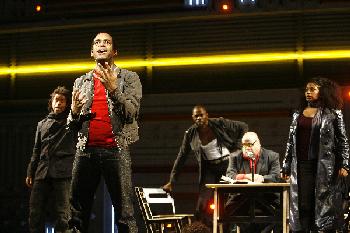
When I reviewed this terrifically enjoyable show downtown (see below), I imagined that, no matter how in need of people like Stew the theater might be, the project was a detour for him. I am guessing it still is, though his journey from California to Amsterdam and Berlin has now taken the theatrical equivalent of the route around Cape Horn. One might think that something would be lost in the transition from the expansiveness of the thrust stage of the Public's Anspacher space to the confines of the Belasco's conventional proscenium, but the opposite is the case. It is just about the only convention to which Stew yields in a show that will displease musical theater purists in ways they hadn't dreamed possible. Yet the farrago of musical styles that Stew employs never shield the deliciousness of his lyrics, a talent which finds rare companions on Broadway or elsewhere. At one point, Stew tells the audience that "at this point in the play we were planning a showtune... But we don't know how to write those kinds of tunes…" The joke, of course, is on anyone who believes him. They may not sound like showtunes, but Stew's clever and effective songs tell stories as well as the best classic showtunes of more classic persuasion. Is the music louder than we might expect in the Broadway enclave? Yes. Is it better than we might expect? That too. In all respects, it rocks. The cast, happily remaining intact from downtown, has become predictably tighter and more expressive, and although Daniel Breaker continues to impress us with his performance, his stage presence now gives his alter ego Stew a real run for his money. The remaining cast also captures our attention repeatedly, though the snippets in which they are seen makes any sort of full development impossible. Which brings us to the dramaturgy, the only complaint I had with the original production. Though there is evidence of a bit of editing and refining along the way, the fundamental flaws continue. We can ride along with Stew and company until the intermission, but the wheels still fall off the narrative cart when we get to Berlin, and even with refinements, the show's ending remains inexplicable and unsatisfying. Basic questions go unanswered, and the show's potential goes unredeemed. It is beyond disappointing that corrabolating director Annie Dorsen has not found the means to correct this. While it certainly does not diminish all that is right with this show, it deprives Passing Strange of the jewel in the crown of its achievement. Credits are same as in original review below, except as noted here: Choreography [previously Movement Coordinator]: Karole Armitage Sound Design: Tom Morse Musicians: Christian Gibbs in lieu of Marc Doten Belasco Theatre, 111 West 44th Street (6/7 Avs) Telephone (212) 239-6200 Opening February 28, 2008, open run TUES @7, WED - SAT @8, WED and SAT @2, SUN @3; $111.50 - $26.50 Last performance7/20/08, after a total of 20 previews and 165 regular performances—and filming by Spike Lee Reviewed by Les Gutman based on 2/24/08 performance |
---Original Off-Broadway Review Follows---
|
Every day I build a mask up to the task now there's no real me i cut clippings from my dreams and move them round til they look like me but there's no real me Call me a collage, of spare parts found in my mind's garage, camouflage you see although my paste on eyes can see right thru all of you. But you can't see me... ---Narrator |
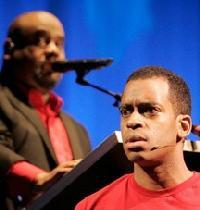 Stew and D. Breaker
(Photo: Michal Daniel) |
Stew narrates Passing Strange, and "narrate" here can mean a whole host of things -- from sitting at a lectern meta-theatrically reading stage directions to jamming with the excellent on-stage band that surrounds him to being the full-out songster that seems organic in him. The action of the piece is executed by a cast of six other talented performers. Daniel Breaker portrays Stew's alter ego, called Youth; Eisa Davis is his Mother. The others portray the multiple characters that Youth meets as he travels from South Central LA to Amsterdam to Berlin and back.
Stew entered the radar screen of The Public Theater through the side door, so to speak. He has been a popular performer at Joe's Pub, and it is to the theater's credit that it recognized that his songwriting gifts deserved the broader and deeper attention that a show like Passing Strange could provide. What one quickly realizes in examining those songs -- which have been widely praised -- is not only their wit and tunefulness but also how incisively they skewer the world they find. Indeed, Stew, who -- with his partner and collaborator, Heidi Rodewald -- sometimes makes music as the group The Negro Problem, is wildly observant. And in our current post-Imus mode, much of what he has to say, and how he says it, strikes me as especially revealing and astute.
Semi-autobiographically, Passing Strange focuses on Youth's self-battles as he reacts to his domineering, misunderstood mother and sets out on a journey through that trio of milestones: sex, drugs and rock and roll. That story is a well-worn one. What makes Stew's telling of it special is that he refracts it through the lens of "passing" -- trying to be something that he is not.
Breaker catapults himself through Youth's adventure effectively and tirelessly. He provides a fine counterbalance to Stew's central energy. Davis is simply wonderful as his mother, conveying a sort of defeated majesty in both acting and her fine singing voice. The other four actors are exceptional not to mention flexible as well. Competing for our attention is a remarkable light wall -- the co-creation of set designer David Korins and lighting designer Kevin Adams.
The centerpiece of the show, though, remains Stew's songs, decidedly rock yet inspired by manifold genres. If I've heard better lyrics in the last several years, these thoughtful, funny, precise ones have made me forget them. If you are a newcomer to Stew's enchantment, as I was, you owe it to yourself to hear what he has to say.
Which brings me to my quibbles. Stew makes no pretense of being anything more than a novice playwright. On his own terms, he has executed exceptionally well. The show, however, suffers dramaturgically. Its narrative is sometimes fuzzy; at times it becomes bogged down; and in the second act it clearly hasn't found its way. It's too bad that in recognizing the potential in bringing Stew's work to theater audiences, the Public didn't take the extra step of providing him with the support his work truly deserves. Director Annie Dorsen does a fine job with the mechanics of staging the show. She's also credited with creative collaboration, however, and in that regard, for whatever reason, she has not done what's needed here.
I don't labor under the misimpression that Passing Strange represents a new direction for Stew, though he would be a most welcome addition to musical theater (and on his own terms). Whatever the future holds, it's terrific he has paid us this visit.
Finally, a bit of trivia on the title. "Passing" is, of course, a reference to persons of color passing themselves off as white. But in the dramatic literature "passing strange" has its own memorable provenance -- one that no doubt did not escape our new friend Stew. Othello tells of courting Desdemona:
When I did speak of some distressful strokeOthello, Act I, scene iii.
That my youth suffered. My story being done,
She gave me for my pains a world of sighs.
She swore, i' faith, 'twas strange, 'twas passing strange;
'Twas pitiful, 'twas wondrous pitiful.
|
Passing Strange
Book and lyrics by StewMusic by Stew and Heidi Rodewald Directed by and created in collaboration with Annie Dorsen with de'Adre Aziza, Daniel Breaker, Eisa Davis, Colman Domingo, Chad Goodridge, Rebecca Naomi Jones and Stew Set Design: David Korins Costume Design: Elizabeth Hope Clancy Lighting Design: Kevin Adams Sound Design: Tony Smolenski IV Movement Coordinator: Karole Armitage Musical Director: Heidi Rodewald Musicians: Christian Cassan (Drums), Marc Doten (Keyboards), Jon Spurney (Keyboards and Guitar) and Ms. Rodewald (Bass, Vocals) Running time: 2 hours, 30 minutes with 1 intermission A Co-Production with Berkeley Repertory Theatre Public Theater (Anspacher), 425 Lafayette (Astor Pl/E. 4th St) Telephone (212) 967-7555 Opening May 14, 2007, closes June 3, 2007--extended to 7/01/07 TUES and SUN @7, WED - SAT @8, SAT - SUN @2 (no performance 5/15); $30-60, students $25, rush $20 (1 hour prior to curtain, cash only) Reviewed by Les Gutman based on 5/13/07 performance Musical Numbers Act 1 Prologue (We Might Play All Night)--Narrator, Heidi and the Band Baptist Fashion Show--Narrator and Ensemble Blues Revelation/Freight Train--Narrator and Ensemble Arlington Hill--Narrator Sole Brother--Youth, Terry and Sherry Must've Been High--Narrator Mom Song--Narrator, Mother and Ensemble Merci Beaucoup, M. Godard--Narrator and Stewardesses Amsterdam--Ensemble Keys--Marianna, Youth and Narrator We Just Had Sex--Youth, Marianna and Renata Act 2 May Day--Narrator and Ensemble Surface--Mr. Venus Damage-- Narrator, Desi and Youth Identity--Youth The Black One--Narrator and Ensemble Come Down Now--Heidi and Desi Work the Wound–Youth and Narrator Passing Phase--Youth and Narrator Love Like That--Narrator and Heidi |
Easy-on-the budget super gift for yourself and your musical loving friends. Tons of gorgeous pictures.
Leonard Maltin's 2007 Movie Guide
At This Theater
Leonard Maltin's 2005 Movie Guide

 >
>

©Copyright 2007, 2008Elyse Sommer.
Information from this site may not be reproduced in print or online without specific permission from esommer@curtainup.com