
SITE GUIDE
SEARCH
REVIEWS
REVIEW ARCHIVES
ADVERTISING AT CURTAINUP
FEATURES
NEWS
Etcetera and
Short Term Listings
LISTINGS
Broadway
Off-Broadway
NYC Restaurants
BOOKS and CDs
OTHER PLACES
Berkshires
London
California
DC
Philadelphia
Elsewhere
QUOTES
On TKTS
PLAYWRIGHTS' ALBUMS
LETTERS TO EDITOR
FILM
LINKS
MISCELLANEOUS
Free Updates
Masthead
Writing for Us
A CurtainUp Chicgo Review
Parallelogram
|
What can we know about ourselves? What can we know about the people closest to us?
— Martha Lavy, artistic director, Steppenwolf Theatre Company
—
|
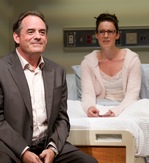
Ensemble members Tom Irwin and Kate Arringto
(Photo credit: Michael Brosilow) |
Combining (and exploiting) the best elements of cGroundhog Daycand The Butterfly Effect, this fast and flippant drama centers on Bee. She's Norris' casebook study in the very un-absolute relativity of hopes and fears. Living in a trendy ground-floor combo and mostly confined to her bed, this young woman cohabits with boyfriend Jay who's estranged from his unseen wife Marcie and kid. (It's enough for this stereotypically regular guy to watch football games as a distraction from death.) The remaining normal character is the lawnboy JJ who will inevitably factor into Bee's future.
The abnormal one is Bee 2, a possible figment of Bee's imagination who nonetheless can foretell events. She does it by means of a magic parallelogram that functions as a remote control allowing Bee to "do over" selected scenes from her ongoing life. It seems that this busy Bee has access to information coming from all the parallel universes that intersect with what we witlessly call the present and allow for a bracing simultaneity of past, present and future. It gives her a detachment that's as creepy as the Grim Reaper's hoodie.
Unfortunately, whatever paltry changes the real Bee makes in the details of her "rewound" moments can't really affect the inevitable outcome as predicted by Bee 2. That, alas, reduces Bee to a present-day Cassandra: Her references to coming events make no sense to the temporal creatures around her. Even worse is her interaction with this unseen" futures" consultant (who warns her about a coming epidemic spread by tropical birds). Bee's outbursts seem crazy or crafty or both.
In subsequent scenes we glimpse Bee's future in a hospital room where she seems to have ventricular cancer (but nothing comes of it) and, year later, where, now shacked up with a lazy JJ, she lives in poverty with occasional visits from Jay who's now uneasily reunited with Marcie. Of course, given this play's gimmick of a time-traveling version of Clarence the angel, Bee is visited by Bee 3 and 4. These emanations assume different forms whose unseen communications with Bee creates all kinds of outrageously predictable comic confusion. (You've seen it all before in Harvey and Blithe Spirit). By the end Bee has learned a perfectly unremarkable lesson—So what if you can't prevent the worst from happening? You can still be nice to people even if you don't mean it.
That unedifying and smug conclusion perfectly fits a playful but deeply cynical drama that plays too much like an illustrated college bull session: "Hey man, what would happen if we all knew just how stupid and pointless everything we did would be until we croak? Pass the bong already. . ."
Anna Shapiro's staging works fairly well to keep the cuteness in check. But there's an unavoidable hip complacency to the playwright's presumed omniscience (and lack of compassion) for these fallible mortals who are too stupid, it seems, to know what comes next. You see it most in Mary Louise Burke's deadpan, chain-smoking Bees 2, 3, 4, all low-key oracles whose no-nonsense descriptions of the awful fates that await these characters are as dispassionate as a stock tip and just as moving.
Despite a role built almost entirely of reactions to Bee's revelations and the skepticism of those around her, Kate Arrington makes Bee as fully fleshed as this guinea-pig anti-heroine can be. Tom Irwin's Jay is equally efficient at displaying his bewilderment at his lover's supposed flights of fancy into the future. Tim Bickel has the thanklessly ethnic role of feckless JJ, a guy whose expectations for the future end with his next beer.
Three hours after you see this, the tricks will wear off and you'll be left only with the two hour drama's thuddingly obvious and mean-spirited point: Whatever happens, we have to get on with our lives and hope for the— well, if not the best— then the not too tragic. What can't be cured must be endured. Get over it. Suck it up. Get used to it. Man up.
I'm sorry but I hate this particular pseudo-philosophy-—and- it's hard to love a play that peddles it like a placebo.
|
Parallelogram by Bruce Norris Directed by Ensemble Member Anna D. Shapiro Cast: Kate Arrington, Tom Irwin with Tim Bickel and Marylouise Burke Sets: Todd Rosenthal Lights:James F. Ingalls Sound: Rob Milburn & Michael Bodeen Dramaturg: Polly Carl Dialect Wet: v Cecilie O'Reilly Stage Manager: Laura D. Glenn Running Time: 2 Hours and 5 minutes Steppenwolf's Downstairs Theatre, 1650 N. Halsted St www.steppenwolf.org From 7/01/10; opening 7/11/10 ; closing 8/29/10 Tuesdays through Sundays at 7:30 p.m. (Sunday evening performances through August 15 only), Saturday and Sunday matinees at 3:00 p.m. Wednesday matinees on August: $20-$70 Reviewed by Lawrence Bommer |
CurtainUp's Annotated List of Chicago Theaters
Guide to links to help Chicago visitors and locals alike find what to do, where to stay and eat.
Chicago Subway Finder & Other Information

 >
>

Guide to links to help Chicago visitors and locals alike find what to do, where to stay and eat.
Chicago Subway Finder & Other Information
>